
Family Tree Connections
by Janet
FamilyTreeConnectionsByJanet.com
P: (386) 566-6636
Discoveries and Stories
from the Past
Every family has mysteries waiting to be solved. Here are a few examples of the stories uncovered through my research — each one a glimpse into the lives and legacies that shaped today’s generations.

For more than a decade, the FindAGrave.com entry for my great-great-grandfather, Louis Julien, was listed as LAUS. The only photo available online was covered in lichen and discoloration. Every document I had said LOUIS.
During a trip to Syracuse, NY, my cousins and I drove 2½ hours north to Notre Dame Cemetery in Ogdensburg to see the stone in person. It was 9 degrees that day — and as someone born and raised in Daytona Beach, Florida, I had never experienced cold like that.
But I brought my tools and as I hopped in and out of the warm car between scrubbing sessions, I slowly cleared away buildup. So the name spelled on the headstone was LAUIS!!!
Not LAUS. Not LOUIS. But LAUIS — a simple stonemason’s misspelling that had confused records for years. Every document confirmed his true name was LOUIS.
The Misprinted Headstone



This cherished portrait offers a look at the Coopey family in England before their 1905 departure for America. It features Henry and Alice (Lavender) alongside their four children — Charles, George, Violet, and infant Ivy — just prior to embarking on the S.S. St. Paul for a new beginning in New Jersey.
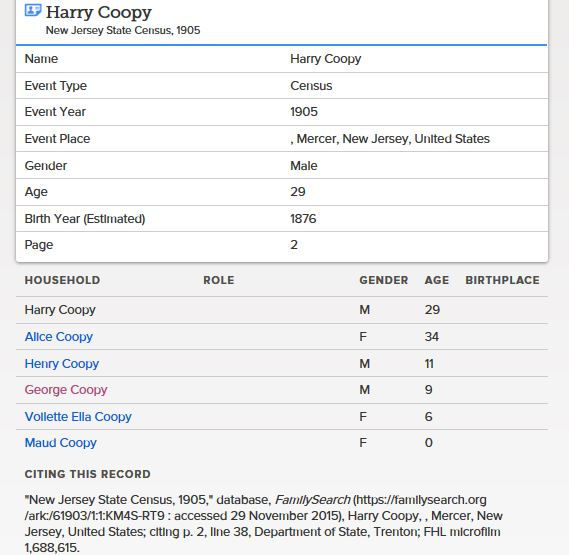
By cross-referencing ship manifests and local directories, I reconstructed their journey and verified their home via the 1905 state census.
The 1910 federal census sadly overlooked their entire block, but I was able to utilized city records to bridge the gap, detailing their careers and evolving family life during those critical early years in America.
Sadly, little Ivy no longer appeared in the records by 1915, though the family continued to grow with the birth of daughter Ruby May Coopey on August 10, 1906.
1905 Coopey Family
Immigration, Missing Census

A Rose by any other name... Stephen Rose Gant
Stephen Rose Gant lived a life that was anything but ordinary and was known to be a very colorful character. Born in 1839, he married three times — first to Hannah Hulse, then to Ann Eliza Irons (with whom he had eight children), and finally to Mary Luker, with whom he had two boys. He died at the age of 89.
He served in the Civil War, Company D, 9th Regiment, New Jersey Volunteer Infantry. His military service stood in stark contrast to the rest of his life.
His life was turbulent and a newspaper account from a trial described him as violent, unpredictable, and often drunk. He was said to be a man who caused chaos everywhere he went.
Stephen was indicted and charged in the death of his first wife, Hannah (married nine months), Hannah, who died after fleeing their house. The defense offered that Stephen was innocent and that Hannah had been gouge by a cow, however there was no evidence of any wounds through her clothes. Stephen was convicted of assault and battery and sentenced to imprisonment for two years, or a fine of $300.
Sometimes, the truth can often be messy, complicated, and human. But, it is always history.


Wrong Name Across Dozens of Family Trees
When I first began working on my Gant line, I kept running into a young woman named Hannah Billsborth. The name appeared on every connected family tree — dozens and dozens of them. Everyone had copied the same information, and no one questioned it. Something just didn't feel right about the name.
So I went straight to an original source and carefully read through a handwritten marriage document. The truth became clear: Her name wasn’t Billsborth. It was simply Bills. The marriage entry stated:
“…I married Zachariah Gant and Hannah Bills, BOTH of the township of Dover.”
There it was — plain, simple, and unmistakable. A clean surname that had somehow morphed into a completely different name across countless online trees.
That experience taught me an important early lesson: Don’t trust every online tree — verify everything.
Billsborth or Bills?
%2C%20Hannah%20marriage%20record%20full%20page.png)


Letters from Emma Lavender-Harris to her nieces Violet and Ruby Coopey
Here is one of several handwritten letters given to me by a favorite cousin of mine, dated London 1921. The letter was written by Emma Lavender‑Harris to her nieces, Violet and Ruby Coopey. It is one of the most meaningful pieces in my collection — not only because of its age, but because it captures a moment of family love, daily life, and connection across an ocean.


The original pages were carefully preserved by family members for more than a century. Her writing is pretty legible and I hope future generations can read Emma’s words clearly. But with schools no longer teaching cursive? I don't know how that will end up.
Her writings offer a glimpse into life in post‑World War I London — the weather, the family news, the gentle humor, and the affection she had for Violet and Ruby. These are the kinds of documents that bring genealogy to life. They remind us that our ancestors weren’t just names and dates; they were people who wrote, laughed, worried, hoped, and loved.